Best Electric Kettles
Buying Guide · Pour-Over Coffee Kettles

A gooseneck kettle doesn’t boil water. It aims it.

A standard kettle spout is built to empty fast into a mug. Pour-over coffee wants the opposite: a slow, narrow, aimable stream that spirals evenly onto the grounds instead of flooding them in one splash. That curved neck is the whole reason this category exists, and once a kettle is shaped for that job, the next real question is how precisely it holds a temperature below boiling, because a few degrees change how the coffee or tea extracts. We compared six gooseneck electric kettles sold in the US on spout control, temperature granularity, capacity, listed wattage, and the keep-warm and timer features that make a morning pour-over routine easier — using only published specifications and current Amazon prices.

6 gooseneck kettles comparedNo testing lab — specs and prices only

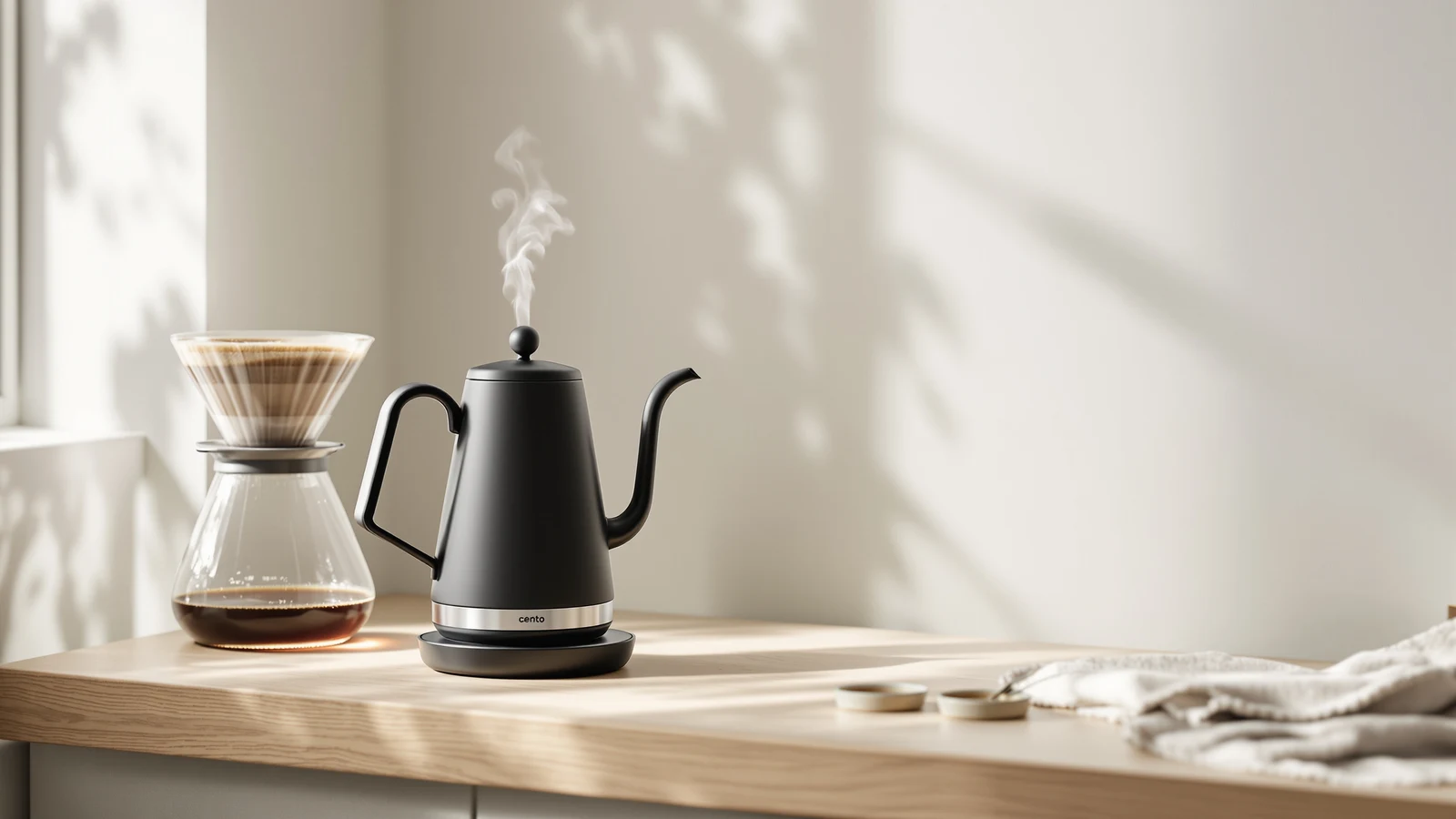
A matte black gooseneck electric kettle pouring a slow, thin stream of water onto coffee grounds in a pour-over dripper on a kitchen counter

This article contains affiliate links. If you buy a kettle through one of them, we may earn a small commission at no extra cost to you — see our methodology for how we choose what to recommend.

The pick for pour-over

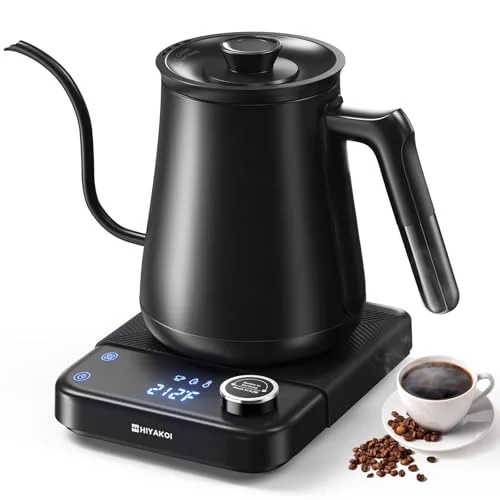
HIYAKOI Gooseneck Electric Kettle, 0.8L

HIYAKOI covers the three things a pour-over kettle needs to get right, at a price well under its rivals here. The maker rates the digital thermostat at ±1°F, which means you set a custom temperature rather than choosing from a short list of presets, and the gooseneck spout is shaped for the slow, aimable pour that even extraction depends on. HIYAKOI also lists a built-in timer, useful for timing a bloom or a multi-pour recipe, and up to 12 hours of keep-warm, far longer than anything else in this group.

At 1,200 watts, it isn’t fast: the listing itself quotes about five minutes to heat its full 0.8 quarts. That is the trade every gooseneck here makes for a controllable pour, not a HIYAKOI-specific weakness. The listing also warns not to touch the stainless body while it’s heating — treat it the way you would any single-wall steel kettle.

0.8 quarts·±1°F custom temperature·12-hour keep warm·Built-in timer
HIYAKOI gooseneck electric kettle with temperature control
Price
$33.99
Check price on Amazon →

Prices change. We refresh them, but Amazon is the authority.

Before you buy

Four things separate a good gooseneck kettle from a bad one.

Flow rate and aim: why pour-over needs a gooseneck

A regular kettle spout is wide and short, designed to empty a liter into a teapot in a few seconds. Pour-over coffee wants the opposite: a long, thin, curved spout that slows the stream to something you can steer, so water lands in a controlled spiral over the grounds instead of punching a hole in the center. That’s the entire job description of a gooseneck. Every kettle in this guide is built around that one spout shape; the differences between them are what’s bolted onto it.

One-degree control, five-degree steps, or presets

Not every gooseneck kettle controls temperature the same way, and the listings are specific about it where they bother to be. HIYAKOI states ±1°F custom temperatures. Cosori offers five presets rather than a dial you set freely. Cuisinart’s GK-1 is described as digital but its listing doesn’t publish an accuracy figure or a preset count. OXO’s Brew and the Fellow Stagg EKG Pro both advertise temperature control — OXO calls it adjustable, Fellow adds a color LCD and a temp-hold function — without a published degree tolerance either. Where a spec isn’t published, we say so rather than guess.

Capacity and wattage in a 0.8 to 1 liter kettle

Gooseneck kettles are small by design, because a narrow spout can’t move much water quickly. The six here run from 0.8 quarts up to 1.1 quarts, and the three that publish a wattage — HIYAKOI, Cosori and the Cuisinart GK-1 — all list 1,200 watts, the common ceiling for this category on a US outlet. Bodum, OXO and Fellow don’t publish a wattage figure at all. More liters at the same wattage simply means a longer wait, so match the size to how many cups you actually pour at once, not to the biggest number on the page.

Hold, timers and the extras worth having

Once a kettle holds a temperature, keeping it there matters almost as much as hitting it. HIYAKOI claims the longest keep-warm here at 12 hours; Cosori lists 60 minutes. A built-in timer, which HIYAKOI, OXO and Fellow all list, helps with bloom times and multi-pour recipes without a phone on the counter. OXO adds a cord-free base, meaning the kettle itself lifts away to pour with no cord in the way, plus automatic shut-off. Fellow’s color LCD and temp-hold function are the closest thing to a dashboard in this group. None of these extras change how the coffee tastes on their own; they change how much friction is in the routine.

Side by side

The six, compared

KettleBest forCapacityTemperatureListed powerPriceGet it
HIYAKOI Gooseneck Pour-over value 0.8 qt Custom, ±1°F 1,200 W $33.99 Get it
Bodum Bistro Simple, no frills 27 oz Boil only Not listed $39.97 Get it
Cosori Gooseneck One-touch presets 0.8 L 5 presets 1,200 W $59.49 Get it
Cuisinart GK-1 Largest capacity 1.1 qt Digital 1,200 W $79.95 Get it
OXO Brew Cord-free pouring 1.1 qt Adjustable Not listed $89.99 Get it
Fellow Stagg EKG Pro Every control 0.9 L LCD, temp hold Not listed $143.95 Get it
The six

Our picks, and who each one is for

01Best overall

HIYAKOI Gooseneck Electric Kettle with ±1°F Temperature Control

Best for most pour-over drinkers, at the lowest price here

0.8 quarts·1,200 watts·±1°F custom temps·12-hour keep warm, built-in timer

HIYAKOI undercuts every other kettle in this guide on price while matching or beating most of them on features that actually affect a pour-over routine: a stated ±1°F accuracy, a built-in timer, and 12 hours of keep-warm, which is longer than any competitor here publishes. The gooseneck spout handles the slow, aimed pour the brew method needs. The honest trade-off is speed — HIYAKOI’s own listing quotes roughly five minutes to boil a full 0.8 quarts at 1,200 watts — and a reminder in the listing not to touch the steel body while it heats.

If you want to find out whether pour-over becomes a daily habit without spending Fellow money, start here.

HIYAKOI gooseneck electric kettle with temperature control in black
Price
$33.99
Check price →
02Best for every control

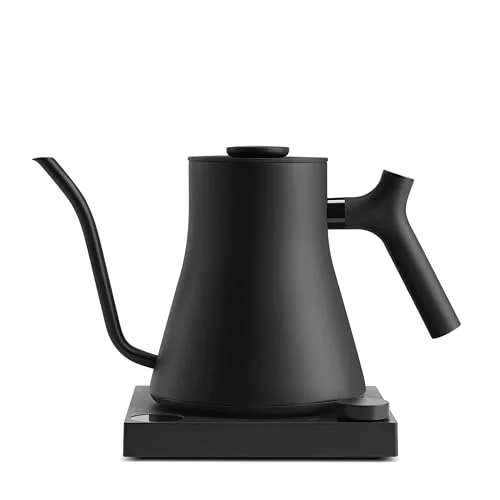
Fellow Stagg EKG Pro Gooseneck Electric Kettle, 0.9 Liter

Best for a daily pour-over habit where control matters more than price

0.9 liter·Temperature control·Color LCD·Temp hold, brew timer

The Stagg EKG Pro is the priciest kettle in this guide, and the listing backs that up with the most dashboard of any of them: a color LCD screen, a temperature-hold function that keeps water at a set point rather than letting it drift once it’s reached, and a built-in brew timer for pacing a multi-pour recipe. Fellow states the kettle heats quickly, though it doesn’t publish a wattage figure to confirm it. At 0.9 liters it’s sized for one or two cups, not a houseful of guests.

The kettle to buy once you already know pour-over is a habit, not an experiment.

Fellow Stagg EKG Pro gooseneck electric kettle in matte black
Price
$143.95
Check price →
03Best presets

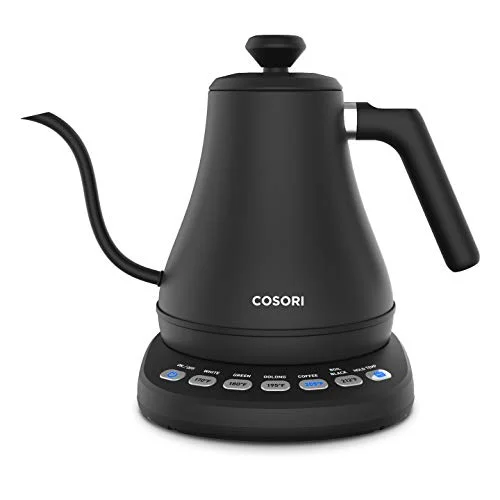
Cosori Gooseneck Electric Kettle with Temperature Control, 0.8L

Best for one-touch brewing without setting a custom degree every time

0.8 L·5 presets·1,200 watts·60-minute keep warm, no plastic contact

Cosori trades a dial-in degree for five fixed presets, which is a reasonable swap if you brew the same couple of recipes most mornings and don’t want to re-enter a number each time. The listing also states no plastic touches the water in this kettle, naming the stainless interior specifically, and the 60-minute keep-warm covers a second cup without a full reheat. At 1,200 watts and 0.8 liters it sits in the middle of this group on both speed and size.

A sensible middle ground between HIYAKOI’s custom degree and a kettle with no temperature control at all.

Cosori gooseneck electric kettle with temperature presets
Price
$59.49
Check price →
04Best larger capacity

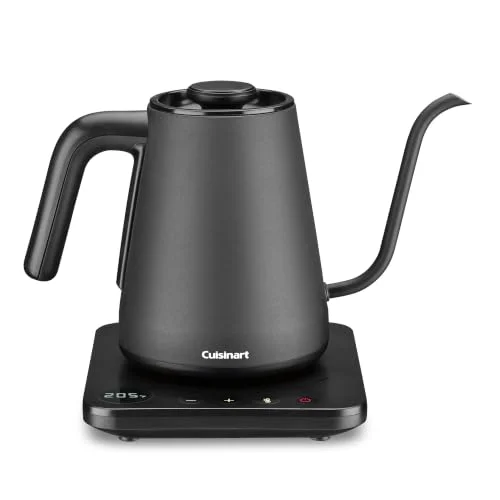
Cuisinart GK-1 Digital Goose Neck Kettle

Best for a bigger pot without leaving the gooseneck behind

1.1 quarts·1,200 watts·Digital controls·Precision gooseneck spout

Cuisinart’s own title calls the GK-1 a 1-liter kettle, and its listed capacity field puts it at 1.1 quarts — either way, it holds more than HIYAKOI or Cosori, which matters if you’re pouring for two or using a larger dripper. The spout is described as precision-shaped specifically for pour control, and the kettle is digital, though Cuisinart’s listing doesn’t publish a degree accuracy or a preset count the way HIYAKOI and Cosori do. At 1,200 watts, the larger fill will take longer to heat than the smaller kettles here.

The one to pick if 0.8 liters feels like one cup short of enough.

Cuisinart GK-1 digital gooseneck electric kettle in black
Price
$79.95
Check price →
05Best cord-free pour

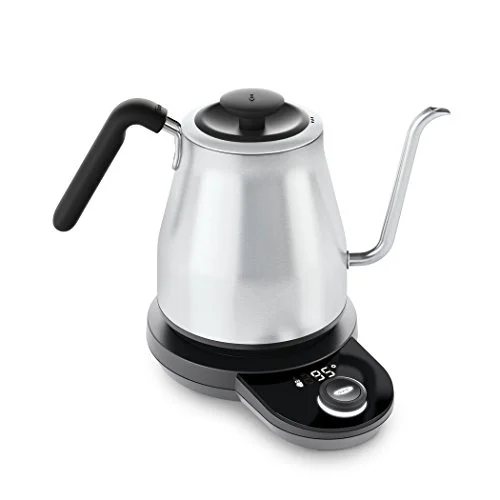
OXO Brew Pour Over Gooseneck Electric Kettle

Best for a cord-free pour and a timer built in

1.1 quarts·Adjustable temperature·Built-in timer·Cord-free base, auto shut-off

OXO’s Brew lifts off a cord-free base, so the cord never swings near the stream while you pour, a small detail that matters more than it sounds once you’re aiming water over grounds. The listing states adjustable temperature control and a built-in timer, plus automatic shut-off, without publishing an exact accuracy figure or a wattage. At 1.1 quarts it’s among the larger kettles here, matching the Cuisinart GK-1 on capacity.

For anyone who finds a trailing power cord the most annoying part of pouring, this solves exactly that.

OXO Brew pour-over gooseneck electric kettle, cord-free base
Price
$89.99
Check price →
06Best simple gooseneck

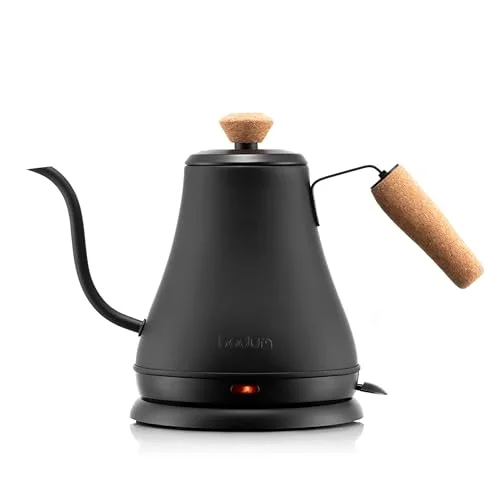
Bodum 27oz Bistro Gooseneck Electric Water Kettle

Best for pour-over without paying for temperature control

27 oz·Stainless steel, matte black·Boil-to-stop operation

Bodum’s listing doesn’t claim a temperature setting, a preset, or a published wattage — this is a gooseneck kettle that boils and switches off, nothing more. For anyone whose pour-over recipe calls for water straight off the boil, or who simply wants the aimable spout without an extra menu to learn, that’s not a missing feature, it’s the whole point. At 27 ounces it holds roughly the same amount as the smaller kettles in this guide.

Proof that the spout, not the thermostat, is what actually makes a kettle a pour-over kettle.

Bodum Bistro gooseneck electric kettle in matte black
Price
$39.97
Check price →
The honest case against upgrading

When a gooseneck without temperature control is enough

Temperature control solves one specific problem: brewing below a full boil. If your pour-over recipe, like most, calls for water in the roughly 195°F to 205°F range, a kettle that only boils forces you to either wait and guess when it’s cooled enough, or brew a little hotter than ideal. A kettle like Bodum’s Bistro skips that control entirely, and the trade mostly disappears if you’re brewing a style that wants water straight off the boil, or if you don’t mind timing the cooldown yourself with a thermometer you already own.

It also disappears if the feature you actually want is the spout, not the thermostat. The gooseneck shape is what lets you control where and how fast the water lands on the grounds; the digital display, the presets and the keep-warm are all built on top of that same spout, not instead of it. A boil-only gooseneck still delivers the slow, aimable pour that a standard kettle can’t, which is the one thing a regular kettle genuinely cannot do for you. If your household also needs a bigger pot of water for tea or a French press that wants a full boil anyway, our main guide to electric kettles covers the full-size, preset-driven options that a small gooseneck isn’t built for.

Where it stops being enough is if you brew more than one style of tea or coffee that call for different temperatures, or if getting the degree wrong noticeably changes how a cup tastes to you. At that point the roughly $20 to $100 gap between Bodum and the controlled kettles above buys something real: a repeatable number instead of a guess.

Our method

How we picked — and what we can’t tell you

What we did

Specs, prices and the physics of a pour

We compared published specifications and current Amazon prices for gooseneck electric kettles sold in the US, and kept the ones whose listings commit to something checkable: a capacity, a temperature control method, a keep-warm time, a timer, or materials that touch the water. We weighted spout design and temperature granularity above anything the listing claimed about boil speed, because on a US outlet, wattage and fill level set the clock far more than the brand does. Where a listing publishes a number — HIYAKOI’s ±1°F, Cosori’s five presets, Cuisinart’s 1,200 watts — we use it; where it doesn’t, we say "not listed" rather than estimate one. More on how we run this site is on our about page.

What we didn’t

We don’t run a testing lab

We do not physically test these kettles, we do not own them, and we do not publish invented scores or star ratings. None of the six products in this guide have verified rating or review-count data available to us, so we don’t cite any — we would rather show nothing than make something up. Whether a thermostat stays accurate for years, or a hinge holds up to daily use, can’t be answered from a spec sheet, and we won’t pretend otherwise. What we can do honestly is read every listed specification, compare them side by side, and explain what each one means for a pour-over routine.

FAQ

Common questions

Do I need a gooseneck kettle for pour-over coffee?

Not strictly, but it makes the brew easier to get right consistently. Pour-over extraction depends on water landing evenly over the grounds in a controlled spiral rather than all at once, and a gooseneck’s long, thin, curved spout is shaped specifically to let you aim and slow that stream. A standard kettle can make pour-over coffee, but the wide, short spout makes an even pour much harder to repeat cup after cup.

What temperature should I brew pour-over coffee at?

This is general brewing guidance, not a spec from any single kettle: most pour-over recipes call for water roughly between 195°F and 205°F, just below a full boil. Hotter water extracts faster and can pull out bitter compounds; cooler water under-extracts and tastes flat or sour. A kettle with a digital readout or presets, like the ones above, makes hitting that range repeatable without a separate thermometer.

Do I need ±1°F accuracy, or are presets close enough?

For most people, presets or even a boil-only kettle are close enough, because a degree or two rarely changes a cup enough to notice. HIYAKOI’s stated ±1°F control matters most if you’re deliberately comparing the same coffee at different temperatures, or brewing delicate teas where a few degrees genuinely changes the result. Cosori’s five presets or a basic boil-only gooseneck like Bodum’s Bistro cover the common cases with far less to think about.

Is a gooseneck kettle slower than a regular kettle?

Usually, yes, for two compounding reasons. Gooseneck kettles hold less water — the ones in this guide run 0.8 to 1.1 quarts versus 1.7 liters or more for a full-size kettle — and the three here that publish a wattage figure all list 1,200 watts, below the roughly 1,500-watt ceiling common on full-size kettles on a US outlet. Less water at lower wattage still adds up to a shorter wait in absolute terms, but liter for liter, a gooseneck is the slower of the two.

Keep reading

More from Best Electric Kettles